They explain the variations in the properties of the elements
The big idea
The periodic table is not just a list. Elements are arranged so that their properties repeat in a predictable
pattern — periodically. Once you know the four trends on this page, you can predict which of two atoms is bigger,
which holds its electrons more tightly, and which end of a bond the shared electrons will sit closest to —
without looking up a single number.
Everything here is explained by exactly two ideas: the effective nuclear charge (Zeff) and the
number of energy levels (the shielding effect). Learn to reach for the right one and every trend explanation
writes itself.
The four definitions
Trend
Definition
Where it matters
Atomic radius
Half the distance between the nuclei of two bonded atoms — i.e. the size of the atom.
Size comparisons; underlies every other trend
Ionization energy
The energy required to remove an electron from an atom in the gas phase (endothermic).
Ionic bonding in metals — the loss of electrons
Electron affinity
The energy released when a negative ion forms from a gaseous atom (exothermic).
Ionic bonding in non-metals — the gain of electrons
Electronegativity
The tendency of an atom to attract electron density towards itself when it is covalently bonded.
Covalent bonding — bond polarity
Don't mix up EA and electronegativity. Electron affinity is a measured energy for a lone gaseous atom
grabbing a free electron (ionic bonding). Electronegativity is a unitless tendency to pull on electrons that are
already being shared in a covalent bond. They trend the same way, but they are not the same quantity.
What you already know — energy levels increase down a group
Going down a group, each element has more electrons, and those extra electrons have to occupy
new, higher energy levels. Hydrogen uses 1 shell, lithium 2, sodium 3, potassium 4.
Going across a period the number of energy levels does not change — every element in period 3 uses
exactly 3 shells. The new electrons all pile into the same outer shell.
Show:
What you need next — Coulomb's Law
F = k Q1Q2r2
Coulombic attraction is the force of attraction between positive and negative charges. In an atom that
means the pull between the protons in the nucleus and the electrons around it.
Q₁More protons ⇒ stronger attraction. The force is directly proportional to the charges.
Q₂More electrons being attracted ⇒ stronger total attraction, for the same reason.
r²Greater distance ⇒ much weaker attraction. The force is inversely proportional to r², so doubling the distance cuts the force to a quarter.
✓Every trend on this site is one of these two effects: more protons pulling harder, or electrons sitting further away.
Where to next
Head to Zeff & the Master Rule — that
single tab is the one that makes every other trend on this page explainable.
Effective Nuclear Charge (Zeff)
The net pull the nucleus has on the valence electrons
Shielding — why the valence electrons don't feel the full nuclear charge
An outer electron is shielded from the pull of the protons by all the electrons sitting between it and the
nucleus. Those core (inner) electrons repel the outer electron and partly cancel the attraction — so the valence
electron feels a smaller, effective nuclear charge.
S = the number of core (inner) electrons doing the shielding.
Zeff is a Coulombic attraction — the net attractive force between the protons in the nucleus and the
valence electrons. The bigger the Zeff, the tighter the atom holds its outer electrons.
Zeff Calculator
Pick an element, or type an electron configuration by shell (e.g. 2,8,5). Core electrons are shown in
blue, valence electrons in rose.
Or type a configuration
Protons (Z)
Protons, Z
15
Core electrons, S
10
Zeff
5
Try:
Handy check. For a main-group element, Zeff comes out equal to the group number (using the
old 1–8 numbering). Phosphorus is in group 5 and its Zeff is 5. If your answer doesn't match the group number,
you have probably counted the valence electrons as core electrons.
How Zeff behaves
increases across a period
Why? The number of protons increases, so the nuclear pull gets stronger. Meanwhile the number of
energy levels stays the same, so no extra shielding is added to cancel that pull out. Na (Zeff = 1) →
Cl (Zeff = 7).
stays constant down a group
Why? Z − S stays roughly the same. The increase in nuclear charge (more protons) is cancelled out by
the increase in the number of core/shielding electrons. Li, Na, K and Cs all have Zeff = 1.
Show:
The master rule — for every trend explanation
Rule Pick your explanation by direction
ACROSS a period →
Explain it with the effective nuclear charge (Zeff). More protons pulling on electrons in the
same energy level.
DOWN a group ↓
Explain it with the increased number of energy levels (the shielding effect). Valence electrons sit at a
greater average distance from the nucleus.
Never explain a trend using something that is constant in that direction.
Zeff is constant down a group — so "Zeff increases down the group" is always wrong.
The number of energy levels is constant across a period — so "there are more energy levels across the period"
is always wrong. If it doesn't change, it can't be the cause.
This one rule is worth more marks than any single fact in this unit. Every "why" answer
starts by identifying the direction first, then reaching for the matching cause.
Interactive Periodic Trend Map
Pick a property — see the direction it moves across and down
Choose a trend
Brighter cells = larger values. Click any element for its value. The arrows show the
direction the property increases. Main-group elements only — the transition metals follow the
same period / group logic but are left out here so the whole table fits on screen.
across a period
down a group
lowhigh▪ picometres (pm)▪ grey = no meaningful value
Click an element to see its value.
The summary diagram from class
Property
Across a period →
Down a group ↓
Atomic / ionic radius
decreases
increases
Ionization energy
increases
decreases
Electron affinity
increases
decreases
Electronegativity
increases
decreases
Zeff
increases
constant
Atomic size is the odd one out. It goes the opposite way to the other three. That makes sense:
IE, EA and electronegativity are all measures of how strongly an atom pulls on electrons, and an atom pulls
hardest when its valence electrons are closest to the nucleus — i.e. when it is small.
So there is really only one thing to remember: the smaller the atom, the harder it holds and attracts
electrons. Fluorine — tiny, top right — is the champion at all three. Francium and caesium — huge, bottom left —
are the worst at all three.
Trend: Atomic Radius
Half the distance between the nuclei of two bonded atoms
The definition
You cannot measure a single atom with a ruler — an atom has no hard edge. Instead you measure the distance
between the nuclei of two bonded atoms and take half of it. That half-distance is the
atomic radius, and it is the closest thing we have to "the size of the atom".
Trend & explanation
decreases across a period
Why? Zeff increases. Going across a period there is an increasing number of protons and an
increasing number of valence electrons being added to the SAME energy level. That increased attraction
pulls the energy levels in closer to the nucleus, shrinking the atom.
increases down a group
Why? There is an increase in the number of energy levels. Valence electrons are being added to
increasingly higher energy levels at a greater average distance from the nucleus. This increases the size
of the atom.
Show:
Class examples
Which atom is larger: Na or Cl?
1Na and Cl are both in period 3 — this is an across a period comparison, so use Zeff.
2Cl has more protons (17 vs 11) with the same 3 energy levels, so Cl has the larger Zeff (7 vs 1).
3The stronger pull draws Cl's valence electrons in tighter, so chlorine is the smaller atom.
✓Na is larger (190 pm vs 79 pm).
Which atom is larger: Li or Cs?
1Li and Cs are both in group 1 — this is a down a group comparison, so use the number of energy levels.
2Li uses 2 energy levels; Cs uses 6. Cs's valence electron is far further from the nucleus.
3Do not say "Cs has a bigger Zeff" — Zeff is constant down a group (both are 1).
✓Cs is larger (298 pm vs 167 pm) — in fact it is one of the largest atoms there is.
Trend: Ionic Radius
What happens to size when an atom becomes an ion
Cations are smaller than the parent atom
Why? To form a cation an atom must lose its outer electrons. In some cases that means losing an
entire energy level (Na 2,8,1 → Na⁺ 2,8). In other cases it means minimising electron–electron
repulsion, letting the remaining electrons be pulled in tighter. Either way, the ion is smaller.
There is a second effect: the ion still has all its protons but fewer electrons, so each remaining electron
gets a bigger share of the nuclear pull.
Anions are larger than the parent atom
Why? To form an anion an atom must gain electrons. The additional electrons cause
electron–electron repulsion, which pushes the electrons away from each other — they spread out more,
making the ion larger.
Same protons, more electrons — so the nuclear pull is now shared among more electrons and each one is held
a little more loosely.
Atom ⇄ Ion size visualiser
Pick a species below, then press play to watch the atom change size as it becomes an ion. Circles are drawn to scale.
Atom radius
—
Ion radius
—
Cations — metals losing electrons
Anions — non-metals gaining electrons
Note: going across a period and down a group, ionic radius follows the same trend
direction as atomic radius — bigger down a group, smaller across a period. Compare Li⁺ → Rb⁺ (0.60 → 1.48 Å) in
the cation row, and F⁻ → I⁻ (1.36 → 2.16 Å) in the anion row.
About the numbers. These radii are quoted in ångströms (Å) from the class slides
(1 Å = 100 pm) and come from a different data set than the picometre radii used elsewhere on this site. Compare
atoms with atoms and ions with ions within a single table — never mix the two sets.
Class examples
Which is larger: K or K⁺?
1K is 2, 8, 8, 1. To become K⁺ it loses its single 4th-shell electron.
2That removes an entire energy level — K⁺ is 2, 8, 8, using only 3 shells.
3The 19 protons now pull on only 18 electrons, tightening the remaining shells further.
✓K is larger (2.31 Å vs 1.33 Å) — the cation is little more than half the size.
Which is larger: Br or Br⁻?
1Br has 7 valence electrons and gains one to complete its octet, forming Br⁻.
2No new energy level is added — but there are now more electrons repelling each other in the same shell.
3That extra electron–electron repulsion pushes the electron cloud outward.
✓Br⁻ is larger (1.85 Å vs 1.14 Å).
Trend: Ionization Energy
Ionic bonding in metals — the loss of electrons
The definition
X(g) + heat → X+(g) + e−
Ionization energy (IE) is the energy required to remove an electron from an atom in the
gas phase. Because energy must be put in, the process is endothermic — which is why "+ heat"
sits on the reactant side of the equation.
The value tells you how strongly an atom's nucleus holds on to its valence electrons. IE is specific to
metals undergoing a loss of electrons in ionic bonding.
Trend & explanation
increases across a period
Why? Zeff increases. Going across a period there is an increasing number of protons and an
increasing number of valence electrons being added to the SAME energy level. The stronger attraction
between the nucleus and the valence electrons makes it more difficult to remove an electron.
decreases down a group
Why? There is an increase in the number of energy levels. Valence electrons sit at a greater average
distance from the nucleus, so the attraction is weaker (the shielding effect) and it becomes
easier to remove an electron.
There are anomalies. The line zigzags: boron dips below beryllium, oxygen dips below nitrogen, and the same
pattern repeats in period 3 (Al below Mg, S below P). You are not expected to explain these in Grade 11 — just know
the overall trend still rises, and don't panic when a graph wobbles.
Reactivity of metals
A metal's reactivity (i.e. metallic character) is inversely related to ionization energy. Metals react by
losing electrons — so the easier an electron is to remove, the more reactive the metal.
decreases across a period
Less metallic character. The increasing attraction between the valence electrons and the protons in the
nucleus makes an atom less likely to lose an electron.
increases down a group
More metallic character. The atomic size is increasing, so the outer energy levels are farther away. The
increased shielding effect lets electrons be lost more readily — the atom is more likely to lose an
electron.
Which is more reactive: Na or Al?
1Both are in period 3 — across a period, so use Zeff.
2Al has a larger Zeff (3 vs 1), so it holds its valence electrons more tightly and has the higher IE (578 vs 496 kJ/mol).
3Reactivity of metals is inversely related to IE.
✓Na is more reactive — it loses its single valence electron far more readily. Al also has to lose three electrons, not one.
Which is more reactive: Li or Cs?
1Both are in group 1 — down a group, so use the number of energy levels / shielding.
2Cs uses 6 energy levels, so its valence electron is far from the nucleus and heavily shielded — its IE is much lower (376 vs 520 kJ/mol).
✓Cs is more reactive. This is exactly why caesium explodes in water and lithium merely fizzes.
Successive Ionization Energies
The first ionization energy removes the first electron; the second removes the second, and so on.
Each successive electron takes more energy than the last, because once the first electron is gone the particle is
positively charged — and the remaining negative electrons are held more tightly by that positive ion.
And there is a quantum leap. Once all the valence electrons have been removed, the next electron must
come out of a full, stable inner shell, and the particle is now much smaller — greater attraction between
the protons and the remaining electrons. The energy needed jumps enormously.
Element:
Class example — which has the larger ionization energy: Mg or Mg²⁺?
1Draw the Bohr models. Mg is 2, 8, 2 — 12 protons, 12 electrons, 3 energy levels.
2Mg²⁺ is 2, 8 — still 12 protons, but only 10 electrons and 2 energy levels. It is much smaller.
3Removing an electron from Mg²⁺ means pulling it out of a full, stable octet, from an ion that is already positively charged and smaller.
✓Mg²⁺ has by far the larger ionization energy — 7733 kJ/mol for its next electron, versus 738 kJ/mol for the first electron of neutral Mg.
Two more: Na vs Al, and Be vs Ba
1Na vs Al — same period, so use Zeff. Al has more protons in the same 3 shells, holds tighter, so Al has the larger IE.
2Be vs Ba — same group, so use the number of energy levels. Be uses 2 shells, Ba uses 6, so Ba's valence electrons are far away and shielded: Be has the larger IE.
Trend: Electron Affinity
Ionic bonding in non-metals — the gain of electrons
The definition
X(g) + e− → X−(g) + heat
Electron affinity (EA) is the energy released when a gaseous negative ion forms from a gaseous atom.
Energy comes out, so the process is exothermic — hence "+ heat" on the product side. It measures the
attraction an atom has for electrons other than its own.
EA is specific to non-metals gaining electrons in ionic bonding. It is the mirror image of
ionization energy: IE is about metals giving, EA is about non-metals taking.
Trend & explanation
more negative across a period
More exothermic — the value 'increases' in magnitude (ignore the sign).
Why? Zeff increases. As the number of protons increases across a period — while the number of
energy levels stays constant — they more strongly attract electrons from other atoms. And non-metals
want to complete their octet.
more positive down a group
Less exothermic — the value 'decreases' in magnitude (ignore the sign).
Why? There is an increase in the number of energy levels. Because of the large distance from the protons
in the nucleus (increased shielding effect), there is less attractive force to add/gain electrons.
The sign trap. Textbooks usually write EA as a negative number because energy is released
(F = −328 kJ/mol). "Largest electron affinity" almost always means largest magnitude / most energy released.
On this page the bars show the magnitude — the energy released — so taller = stronger attraction for an
extra electron.
Show:
Reactivity of the halogens
Reactivity of halogens decreases down a group — the opposite direction to metals, because halogens react by
gaining electrons rather than losing them. The higher the electron affinity, the more reactive the atom.
Why? F is very small and has a strong nuclear pulling force acting on electrons nearby, so it
releases more energy when an electron is gained — making it the most reactive. Going down the group, the
increase in the number of energy levels leads to a decrease in electron affinity: the electron is gained
farther from the nucleus, and less energy is released.
Which is more reactive: Cl or Br?
1Both are halogens in group 17 — down a group, so use the number of energy levels.
2Cl uses 3 energy levels; Br uses 4. Br's incoming electron lands further from the nucleus, with more shielding.
3So Cl releases more energy on gaining an electron (349 vs 325 kJ/mol) — a higher EA.
✓Cl is more reactive. Halogen reactivity falls F > Cl > Br > I.
Class examples: N vs F, and F vs I
1N vs F — same period, so use Zeff. F has more protons in the same 2 shells and needs just one electron to complete its octet: F has the larger EA (328 vs ~0 kJ/mol — nitrogen's half-filled shell makes it unusually reluctant).
2F vs I — same group, so use the number of energy levels. F is tiny (2 shells) and I is large (5 shells), so F releases far more energy: F has the larger EA (328 vs 295 kJ/mol).
Trend: Electronegativity
Covalent bonding — the tug-of-war over shared electrons
The definition
Electronegativity is the attraction an atom has for the shared electrons in a covalent bond — its
tendency to pull electron density towards itself. Unlike IE and EA it has no units: it is a relative scale, with
fluorine set at 4.0 as the most electronegative element.
In water, oxygen (3.5) pulls much harder on the shared pairs than hydrogen (2.1) does. The electrons spend more
time near the oxygen, giving it a partial negative charge δ− and leaving each hydrogen partially positive
δ+. That unequal sharing is what makes water a polar molecule.
Trend & explanation
increases across a period
Why? Zeff increases. The increasing number of protons generates a greater attractive force on
SHARED (covalent) bonding electrons — the closer the valence shell is to full, the stronger the pull of
that atom on the electrons in a bonding pair.
decreases down a group
Why? There is an increase in the number of energy levels. The shared electrons sit in increasingly higher
energy levels at a greater average distance from the nucleus, so there is less attraction of the protons in
the nucleus to the shared bonding electrons.
This gives the classic diagonal arrow from the bottom left of the periodic table to the top right: lowest near
Fr and Cs (0.7), highest at F (4.0). Open the Trend
Map and select electronegativity to see the diagonal light up.
Bond Polarity Tool
Pick two elements to bond together. The tool works out the electronegativity difference (ΔEN) and shows how the
shared pair is distributed.
Atom A
—
Atom B
EN of A
—
EN of B
—
ΔEN
—
non-polar covalent
polar covalent
ionic
Class examples:
The cut-offs are guidelines, not laws. Using the course-notes values: ΔEN of about
0–0.4 is non-polar covalent, 0.4–2.0 is polar covalent, and 2.0 or greater is
ionic. Some tables list 0.4–1.7, 1.8, or 1.9 as the polar-covalent range instead — real bonds sit on a continuous
scale, so there is no switch that flips at one exact number.
Class examples
H–H vs H–F
1H–H: both atoms have EN 2.1, so ΔEN = 0. The pair is shared perfectly equally — a non-polar covalent bond with no δ+ or δ−.
2H–F: F is 4.0 and H is 2.1, so ΔEN = 1.9. Fluorine pulls the shared pair strongly towards itself.
✓H–F is by far the more polar bond — ΔEN = 1.9 makes it a strongly polar covalent bond, just under the ~2.0 cut-off for ionic.
H–F vs H–Br
1F and Br are both in group 17 — down a group, so use the number of energy levels.
2Br uses 4 energy levels to F's 2, so the shared pair sits further from Br's nucleus and is attracted less: EN falls from 4.0 to 2.8.
✓H–F is the more polar bond — the shared pair is pulled much further towards the halogen.
Trend Comparison Tool
Pick two species, pick a property — then justify it before you get the answer
Compare
Species A
Species B
Property
Before you see the answer: which explanation should you use here?
Every example from the class slides
Load one and work through the reasoning.
Atomic radius
Atomic vs ionic radius
Ionization energy
Metal reactivity
Electron affinity & halogen reactivity
Electronegativity
Bond polarity — these open the polarity tool
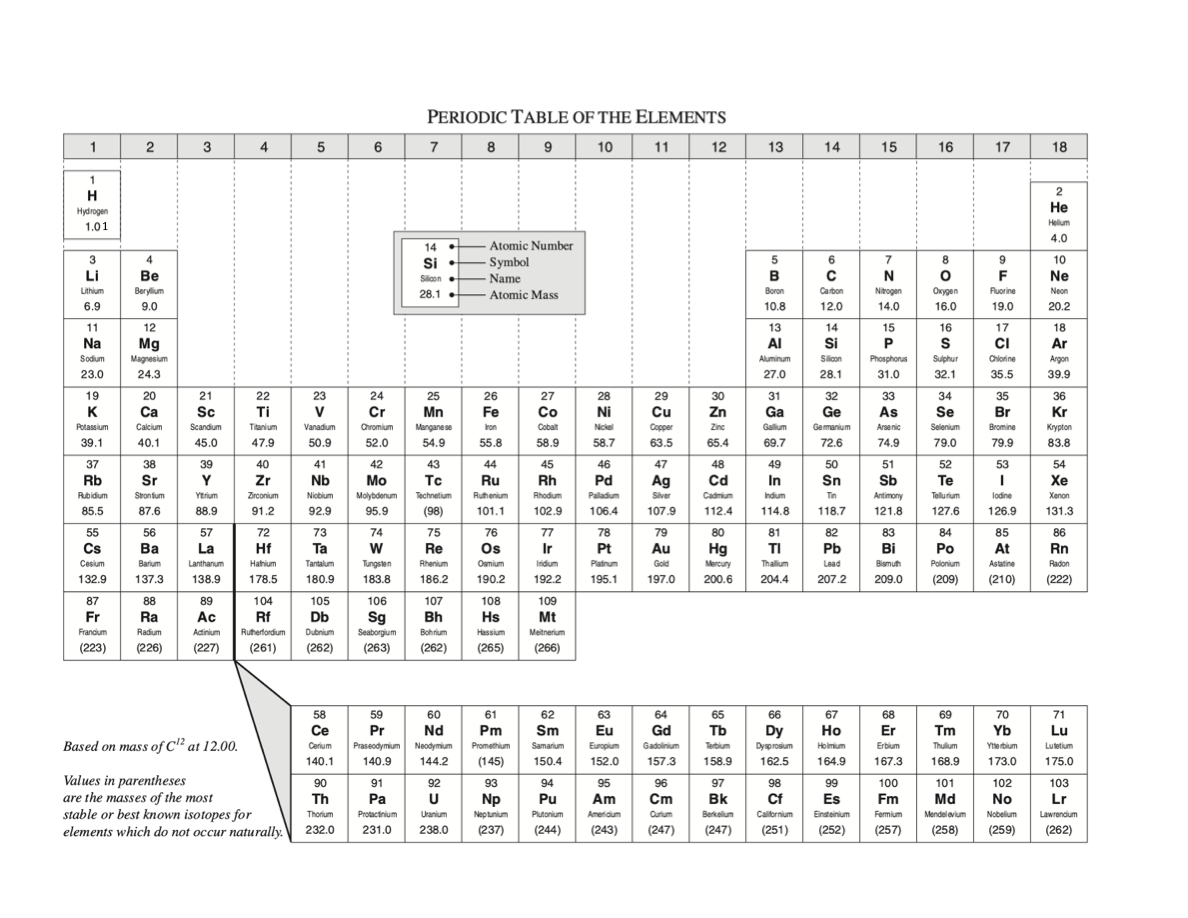
Periodic Table
Class-standard table · based on mass of carbon-12 = 12.00
Every trend on this page reads off the table's shape: rows are periods (across), columns are groups (down).
"Explain the Trend" Practice
The exam question is never "what" — it is always "why"
How to answer a "why" question
1Identify the direction. Are the two elements in the same period (across) or the same group (down)?
2Pick the matching cause. Across → Zeff. Down → number of energy levels / shielding.
3Say what changes. More protons pulling on the same shell — or valence electrons in a higher shell, further away.
4Link it to the property. "…so the atom holds its electrons more tightly, so the ionization energy is higher."
Never cite something that is constant in that direction. Zeff does not change down a group; the number of
energy levels does not change across a period. Using either one in the wrong direction is the single most common
way to lose the mark.
Practice — pick the correct reasoning
Score: 0 / 0 ·
Summary
Quick reference for the whole unit
The trends at a glance
Property
What it is
Across →
Down ↓
Atomic radius
Half the distance between two bonded nuclei
decreases
increases
Ionic radius
Radius of the ion — cations smaller, anions larger than the parent
decreases
increases
Ionization energy
Energy required to remove an e⁻ (endothermic, metals)
increases
decreases
Electron affinity
Energy released forming an anion (exothermic, non-metals)
increases
decreases
Electronegativity
Pull on shared electrons in a covalent bond
increases
decreases
Zeff
Z − S — net nuclear pull on the valence electrons
increases
constant
Metal reactivity
Inversely related to ionization energy
decreases
increases
Halogen reactivity
Follows electron affinity
—
decreases
The two explanations — that's all there is
Rule Direction decides the reason
ACROSS →
Zeff increases. More protons, same number of energy levels, no extra shielding — a stronger pull on
the valence electrons.
DOWN ↓
More energy levels (shielding). Valence electrons sit further from the nucleus and are screened by more core
electrons — a weaker pull.
Constant things explain nothing. Zeff is constant down a group. The number of energy levels is constant
across a period.
Common mistakes to avoid
✗Explaining a down-a-group trend with Zeff. It doesn't change down a group.
✗Explaining an across-a-period trend with shielding or extra energy levels. They don't change across a period.
✗Counting the valence electrons as core electrons in Zeff = Z − S. Only inner shells shield.
✗Saying a cation is bigger because it "lost repulsion" — losing electrons always makes it smaller; gaining electrons always makes it bigger.
✗Getting the EA sign backwards. More negative = more energy released = stronger attraction for an electron.
✗Assuming metal and halogen reactivity trend the same way down a group. Metals get more reactive, halogens get less — because one loses electrons and the other gains them.
✗Confusing electron affinity (ionic bonding, a measured energy) with electronegativity (covalent bonding, a unitless tendency).
Where to next
See these trends in the real world on the
Real-World Applications page — alkali metals in
water, halogen reactivity, why water is polar and why noble gases glow but never react — then test yourself with the
practice quiz.
Related units: Atomic Structure for electron
configurations and Bohr-Rutherford diagrams, and
Chemical Bonding — Bohr Model for what happens once those
electrons are actually transferred or shared.