The Bohr-Rutherford model — a nucleus surrounded by energy levels
What the model says
Protons and neutrons sit together in a tiny, dense nucleus at the centre of the atom.
Electrons occupy energy levels (shells) around that nucleus. Almost all of the atom's mass is in the
nucleus, but almost all of its volume is empty space where the electrons move.
proton (p⁺) neutron (n⁰) electron (e⁻)
Show:
Properties of the subatomic particles
Particle
Symbol
Location
Relative mass
Charge
Proton
p⁺
Nucleus
1
+1
Neutron
n⁰
Nucleus
1
0
Electron
e⁻
Energy levels (shells)
1/1840
−1
An electron has only about 1/1840 the mass of a proton or a neutron. That is why the mass number
counts only protons and neutrons — the electrons contribute almost nothing to the mass of the atom.
Careful — this model is a simplification. The Bohr-Rutherford picture of neat, concentric shells works well for
the first ~20 elements (up to about 20 protons). Beyond that, electrons fill sub-levels in an order that this simple
2 / 8 / 8 picture no longer predicts correctly. You will meet the full quantum model in Grade 12.
Why the atom is neutral
In a neutral atom, the number of positive protons exactly equals the number of negative electrons, so the charges
cancel: (+1 × p) + (−1 × e) = 0. Change the number of electrons and you no longer have an atom — you have an
ion. Change the number of protons and you no longer have the same element at all.
Related page: bonding happens when atoms share or transfer those outer electrons — see the
Chemical Bonding — Bohr Model simulation.
Atomic Number, Mass Number & Standard Atomic Notation
Z = protons · A = protons + neutrons
Atomic number, Z
Z = number of protons
The atomic number is the fingerprint of an element. Every carbon atom in the universe has exactly 6 protons —
if it had 7, it would be nitrogen. Z is what the periodic table is ordered by.
In a neutral atom, Z also tells you the number of electrons.
Mass number, A
A = protons + neutrons
The mass number counts the heavy particles in the nucleus. It is always a whole number — you cannot have half
a neutron. Rearranged: number of neutrons = A − Z.
Do not confuse A with the decimal mass on the periodic table — that decimal is the average atomic mass
of all the isotopes (see the Average Atomic Mass tab).
Standard atomic notation — explore it
Mass number goes top-left, atomic number goes bottom-left of the element symbol. Pick an element, then
drag the neutron slider to change the mass number.
▲ mass number (A) ·
▼ atomic number (Z)
6
Protons (Z)
6
Neutrons (A−Z)
6
Mass number (A)
12
Worked example — Aluminum-27
2713Al
1The bottom-left number is the atomic number, Z = 13, so aluminum has 13 protons.
2The top-left number is the mass number, A = 27 — the total of protons and neutrons.
3Neutrons = A − Z = 27 − 13 = 14 neutrons.
4It is written as a neutral atom, so electrons = Z = 13 electrons.
Isotopes
Same protons · different neutrons · different mass
The definition
Isotopes are atoms of the same element (same number of protons) that have different numbers of
neutrons, and therefore different mass numbers. Because Z is unchanged, they are still the same element —
only the nucleus is heavier or lighter.
Isotope Explorer
Element:
0 n⁰
Protons — fixed
1
Neutrons — changes
0
What stays the same
Chemical properties are identical. Chemistry is controlled by the valence electrons, and isotopes of an
element all have the same number of protons — so the same number of electrons, arranged the same way. C-12 and C-14
both form four bonds and both burn to CO₂.
What changes
Physical properties differ because the mass differs — density, rate of diffusion, and boiling point shift slightly.
Some isotopes also have unstable nuclei: these are radioisotopes, which decay and release radiation.
Tritium (H-3) and carbon-14 are the examples from class.
Fun fact — the radioactive tail of the periodic table
Every element beyond atomic number 88 is radioactive. Once a nucleus contains that many protons, no combination
of neutrons can hold it together indefinitely — the repulsion between so many positive charges always wins eventually.
That is why elements like uranium (Z = 92) and plutonium (Z = 94) have no stable isotopes at all.
Calculating Subatomic Particles
From A, Z and charge → protons, neutrons, electrons
The three rules
pNumber of protons = Z. Always. The atomic number never changes for an element.
nNumber of neutrons = A − Z. Mass number minus atomic number.
eNumber of electrons = Z for a neutral atom. Then add 1 e⁻ for every negative charge and subtract 1 e⁻ for every positive charge.
Why the charge rule works that way. A negative ion is negative because it gained electrons — so a 2− charge
means 2 extra electrons. A positive ion is positive because it lost electrons — so a 2+ charge means 2 fewer electrons.
The protons never change; only electrons move.
Subatomic Particle Calculator
Element
Atomic number Z
Mass number A
Charge
Protons
—
Neutrons
—
Electrons
—
Load:
Worked example — Fe-55 vs Fe-57
Iron is Z = 26, so both have 26 protons and (as neutral atoms) 26 electrons. Only the neutrons differ.
Fe-55
Fe-57
Protons
26
26
Neutrons
55 − 26 = 29
57 − 26 = 31
Electrons
26
26
Fe-57 has 2 more neutrons than Fe-55. They are isotopes of the same element.
Worked example — Cl-35 atom vs Cl⁻ ion
Chlorine is Z = 17. The neutral atom and the chloride ion have the same nucleus — the difference is one electron.
Cl atom
Cl⁻ ion
Protons
17
17
Neutrons
18
18
Electrons
17
17 + 1 = 18
The 1− charge means one electron was gained, giving 18 electrons — the same as argon.
Practice problems
Work each one out on paper first, then check. You can also load them into the calculator above.
Electron Configurations
Energy levels · shell capacities 2 / 8 / 8 · the valence shell
Shell capacities
Energy level
Maximum electrons
1st shell (innermost)
2
2nd shell
8
3rd shell
8
Fill from the inside out: the 1st shell must be full before any electron goes into the 2nd, and so on.
These capacities are the simplified Grade 11 rule. Past the third shell it gets complicated — the 4th shell
actually holds 18, and sub-levels start overlapping. Stick to 2 / 8 / 8 for the first 20 elements.
The valence shell
The valence shell is the outermost occupied shell, and the electrons in it are the
valence electrons.
Valence electrons determine bonding and reactivity — they are the only ones close enough to the outside of the
atom to interact with another atom. An atom with a full valence shell (2 or 8) is stable and unreactive, which is
why the noble gases barely react at all.
This is also why isotopes of an element behave identically in chemical reactions — changing neutrons doesn't
change the valence electrons at all.
Electron Configuration Builder
Pick an element, then add or remove electrons to make an ion. Watch the shells fill from the inside out — the
highlighted row is always the valence shell.
Charge:
Worked example — chlorine atom vs chloride ion
Chlorine atom, Cl
17 protons · 17 electrons · neutral
2, 8, 7
7 valence electrons — not full, so it is very reactive
Chloride ion, Cl⁻
17 protons · 18 electrons · charge 1−
2, 8, 8
8 valence electrons — full shell, stable like argon
Chlorine gains one electron because that is all it needs to complete its third shell (7 → 8). The nucleus still has
17 protons, so with 18 electrons the atom now carries a 1− charge.
Reference configurations
The elements shown in class, with their shells filled by the 2 / 8 / 8 rule.
Bohr-Rutherford Diagram Builder
Nucleus labels + filled electron shells, drawn for any isotope or ion
How to draw one
1Draw the nucleus as a circle and label it with the number of protons (p⁺) and neutrons (n⁰). Protons = Z; neutrons = A − Z.
2Work out the number of electrons. For a neutral atom that is Z; for an ion, adjust for the charge.
3Draw a ring for the first shell and fill it, then the next ring, and so on — always from the innermost shell outward, with capacities 2, 8, 8.
4Within a shell, place electrons singly at the top, right, bottom and left first, then pair them up.
Build a diagram
Element
Mass number A
Charge
Protons
—
Neutrons
—
Electrons
—
Electron configuration
Presets:
Worked example — Sodium-23
1Sodium is Z = 11, so the nucleus has 11 p⁺. Neutrons = A − Z = 23 − 11 = 12 n⁰.
2It is a neutral atom, so it has 11 electrons.
3Fill the shells: first shell takes 2, second shell takes 8 (10 used), and the last 1 goes into the third shell.
4Configuration: 2, 8, 1 — one lone valence electron, which is exactly why sodium is so reactive and forms Na⁺.
Average Atomic Mass
Why the periodic table masses aren't whole numbers
The idea
Every naturally occurring sample of an element is a mixture of its isotopes, and each isotope makes up a certain
percent abundance of that mixture. The mass printed on the periodic table is the weighted average of those
isotope masses — weighted by how common each one is. That is why it is a decimal, not a whole number.
Average atomic mass = Σ (mass of isotope × % abundance)100
A weighted average is not the same as a plain average. If 99% of a sample is a light isotope, the answer must sit
very close to the light isotope's mass — not halfway between the two.
Average Atomic Mass Calculator
Enter 2–4 isotopes. The abundances must add up to 100%.
Isotope label
Mass (u)
Abundance (%)
—
u (atomic mass units)
Presets:
Worked example — chlorine
Naturally occurring chlorine is about 75% ³⁵Cl and 25% ³⁷Cl.
1Multiply each isotope's mass by its percent abundance: 35 × 75 = 2625 and 37 × 25 = 925
2Add them: 2625 + 925 = 3550
3Divide by 100: 3550 ÷ 100 = 35.5
4Average atomic mass of chlorine = 35.5 u — which is exactly what the periodic table shows (35.45).
Notice the answer is closer to 35 than to 37, because ³⁵Cl is three times more abundant. A plain average of 35 and 37
would have given 36 — wrong.
Try it yourself — silicon
Silicon has three naturally occurring isotopes. Calculate the average atomic mass, then check your answer.
Isotope
Mass (u)
Abundance (%)
Si-28
27.977
92.21
Si-29
28.976
4.70
Si-30
29.974
3.09
Show the full solution
1Si-28: 27.977 × 92.21 = 2579.87
2Si-29: 28.976 × 4.70 = 136.19
3Si-30: 29.974 × 3.09 = 92.62
4Total = 2579.87 + 136.19 + 92.62 = 2808.68
5Divide by 100: 2808.68 ÷ 100 = 28.09 u
✓The periodic table gives silicon as 28.09 u — a match. Because Si-28 makes up over 92% of the mixture, the answer sits very close to 28.
The magnesium strip exercise — which method is valid?
Three students each propose a way to work out the average atomic mass of magnesium from its isotope data.
Click each model to decide whether it is mathematically valid.
Isotope
Mass (u)
Abundance (%)
Mg-24
23.985
78.99
Mg-25
24.986
10.00
Mg-26
25.982
11.01
Model 1 — percent method
Multiply each mass by its percent abundance, add them all up, then divide the total by 100.
= 24.31 u
Model 2 — decimal fraction method
Convert each percentage to a decimal fraction first (78.99% → 0.7899), multiply each mass by its fraction, then add.
= 24.31 u
Model 3 — simple average
Add the three isotope masses together and divide by 3, ignoring the abundances.
= 24.98 u
Mass Spectrometry
How isotope masses and abundances are actually measured
How a mass spectrometer works
1Vaporise. The sample is turned into a gas so that individual atoms are free to move.
2Ionise. The gaseous sample is bombarded with high-energy electrons, which knock electrons off the atoms and turn them into positive ions (cations).
3Accelerate. The cations are pulled through charged plates, so they all enter the next stage moving quickly.
4Deflect. A magnetic field bends the path of each ion. Lighter isotopes are deflected more than heavier ones — a bigger charge-to-mass ratio means a bigger deflection, so their paths curve more sharply.
5Detect. The ions strike a detector. Each mass lands in a different place, and the current produced — the height of the peak — is proportional to how abundant that isotope is.
Mini mass spectrometer
Sample:
lighter isotope — deflected more heavier isotope — deflected less
Reading the neon spectrum
The mass spectrum of neon shows three peaks. Their positions give the mass numbers; their heights give the
percent abundances.
Isotope
Mass number
Abundance
Peak
Neon-20
20
90.92%
Tallest by far
Neon-21
21
0.26%
Barely visible
Neon-22
22
8.82%
Small but clear
Feed those numbers into the weighted-average formula and you get
(20 × 90.92 + 21 × 0.26 + 22 × 8.82) ÷ 100 = 20.18 u — exactly the value printed on the periodic table for neon.
That is how the periodic table's masses were determined in the first place.
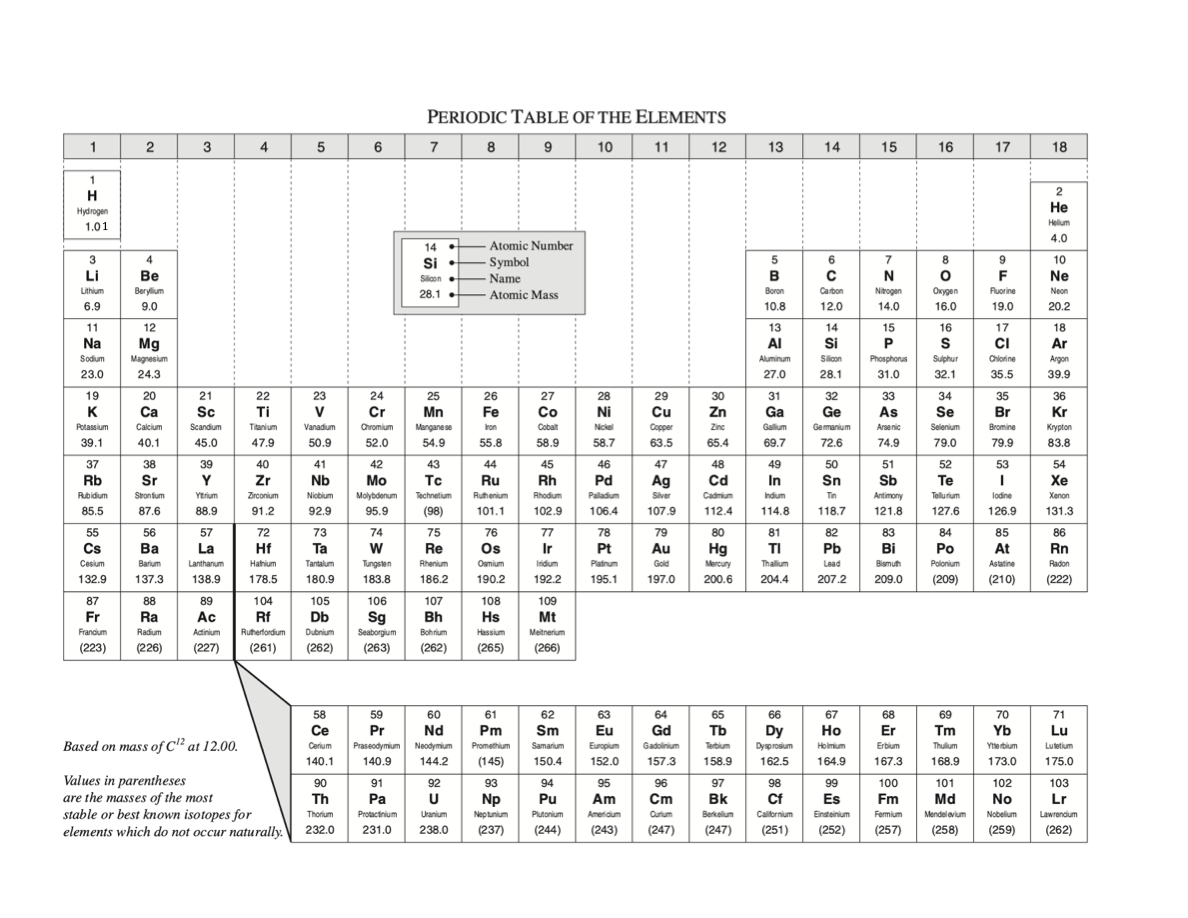
Periodic Table
Class-standard table · based on mass of carbon-12 = 12.00
Use this table for atomic numbers, mass numbers and the printed average atomic masses.
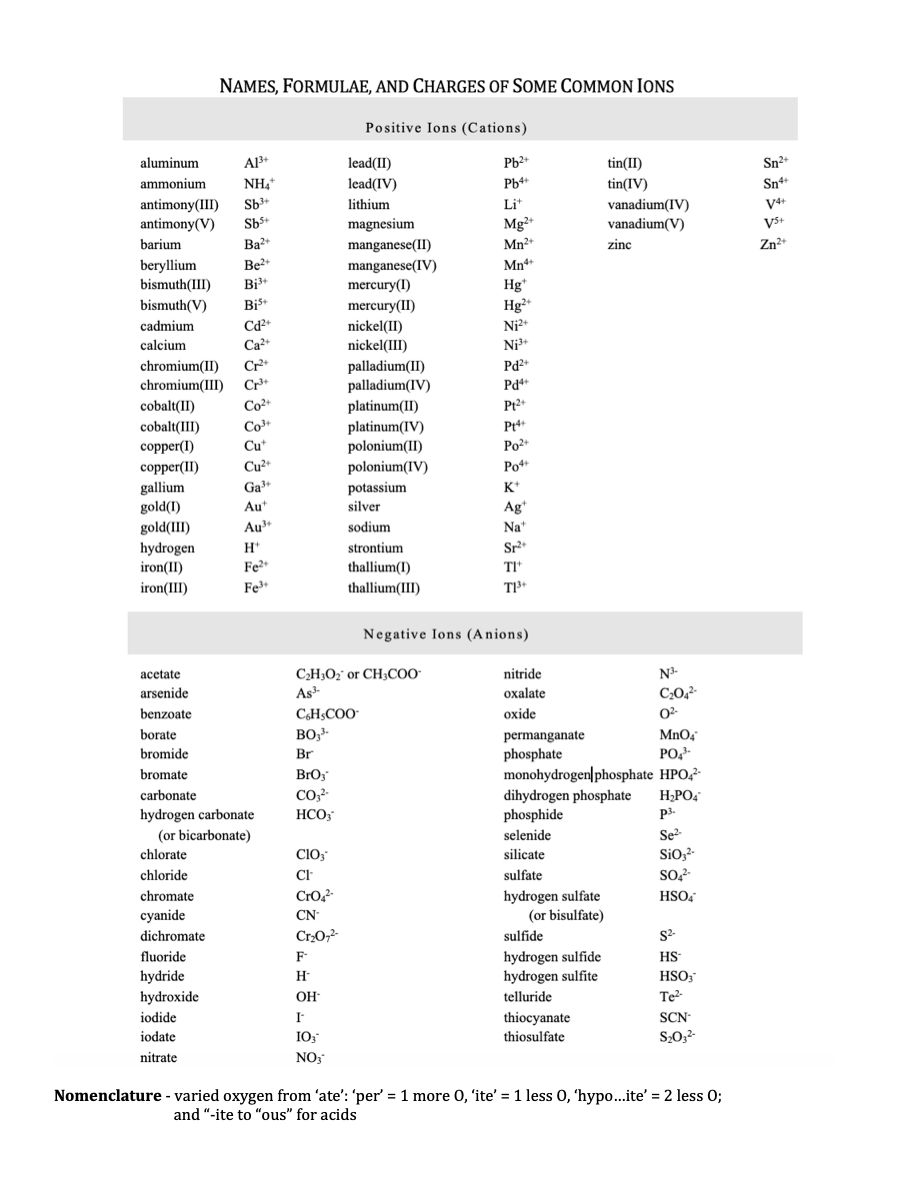
Ion Chart
Class-standard chart · common cations, anions & polyatomic ions with their charges
Once an atom gains or loses electrons it becomes an ion — this chart lists the charge each common ion carries.
Summary
Quick reference for the whole unit
Key relationships
Quantity
How to find it
Note
Z Atomic number
= number of protons
Identifies the element — never changes
A Mass number
= protons + neutrons
Always a whole number
Neutrons
= A − Z
Differs between isotopes
Electrons (atom)
= Z
Neutral atom only
Electrons (ion)
= Z − charge
+1 e⁻ per negative charge, −1 e⁻ per positive charge
Shell capacities
2, 8, 8
Fill from the inside out (first 20 elements)
Valence electrons
= electrons in the outermost shell
Control bonding and reactivity
Average atomic mass
= Σ(mass × % abundance) ÷ 100
The decimal on the periodic table
Common mistakes to avoid
✗Using the decimal periodic-table mass as the mass number. A must be a whole number — round the table value, or use the value given in the question.
✗Changing the proton count to make an ion. Ions are made by gaining or losing electrons only.
✗Getting the charge rule backwards. Negative charge = extra electrons; positive charge = missing electrons.
✗Taking a plain average of isotope masses instead of a weighted one.
✗Filling an outer shell before the inner one is full. Always innermost first: 2, then 8, then 8.
Where to next
Try the Real-World Applications page for carbon dating,
medical radioisotopes and forensic mass spectrometry — then test yourself with the
practice quiz.