Nomenclature — Interactive Study Tool

SCH3U · Unit 1a · Elemental molecules · Covalent · Ionic · Hydrates

← All units
Naming and Writing Formulas for Chemical Compounds
Read a formula → decide the type → apply that type's rules
Four kinds of substance you name in Unit 1a
Elemental molecules

Two (or more) atoms of the same non-metal bonded together. The seven diatomic elements: H2, N2, O2, F2, Cl2, Br2, I2 — plus their friends P4 (phosphorus) and S8 (sulfur). The name is just the element — "hydrogen", "chlorine", "phosphorus". No prefixes, no "-ide".
Covalent (molecular) compounds

Two different non-metals sharing electrons. Greek prefixes say how many of each atom: CO2 = carbon dioxide, OF2 = oxygen difluoride. Second element ends in "-ide".
Ionic compounds

A metal (or NH4+) transfers electrons to a non-metal or polyatomic ion. Name = metal/cation name, then non-metal/anion + "-ide"
Hydrates

An ionic compound with water locked into its crystal lattice. Name the salt, then a prefix + "hydrate" for the water: CuSO4·5H2O = copper(II) sulfate pentahydrate.
Which set of rules do I use? — decision flow
Start: look at the very first part of the formula.
One element, written as a molecule (e.g. O2, also P4 / S8)
→ elemental molecule → name = the element.
Two different non-metals (e.g. N2O4)
→ covalent compound → prefix each element, "-ide" ending.
Metal + non-metal / polyatomic (e.g. CaCl2)
→ ionic compound → metal name + non-metal "-ide". No prefixes.
…·xH2O on the end (e.g. MgSO4·7H2O)
→ hydrate → name the salt, then "(prefix)hydrate".
Common-name exceptions you just memorise: H2O = water · NH3 = ammonia · CH4 = methane.
Greek prefixes — used for covalent compounds & hydrates
#Prefix#Prefix
1mono‑6hexa‑
2di‑7hepta‑
3tri‑8octa‑
4tetra‑9nona‑
5penta‑10deca‑
In a covalent compound the prefix "mono-" is dropped on the first element only — CO2 is "carbon dioxide", not "monocarbon dioxide". In a hydrate name, every prefix including "mono-" is kept ("…monohydrate").
Naming and Formula Writing Rules — by compound type
Open a category for its rules, worked examples, and practice
Elemental molecules — H2, N2, O2, F2, Cl2, Br2, I2 (also P4, S8)
Rule. A few elements never exist as single atoms under normal conditions — the seven diatomic elements pair up (subscript 2), while phosphorus and sulfur travel as the larger molecules P4 and S8. Either way the name is simply the element name — no prefix, no "-ide".
FormulaNameEveryday encounter
H2hydrogenrocket fuel, hydrogen fuel cells
N2nitrogen78% of the air; flush gas in food packaging
O2oxygen21% of the air; what you breathe in
F2fluorinepale-yellow gas, most reactive element
Cl2chlorinepool & drinking-water disinfectant
P4phosphoruswhite phosphorus — match heads, tracer rounds
S8sulfuryellow ring molecule — gunpowder, vulcanised rubber
Memory aid — the "H O F Br I N Cl" seven: H, O, F, Br, I, N, Cl are all diatomic as free elements. HOFBrINCl's friends P4 and S8 are the other elements written as molecules — still named just "phosphorus" and "sulfur", no prefixes.
Practice
1. Write the formula for a molecule of chlorine gas.
Cl2 — two chlorine atoms sharing one pair of electrons.
2. A cylinder is labelled "N2". Is the contents an element or a compound?
An element — only one kind of atom. It is just written as a diatomic molecule. Name: nitrogen.
3. True or false: O2 should be named "dioxygen".
False. Greek prefixes are only for covalent compounds (two different non-metals). An elemental molecule is just "oxygen".
Covalent (molecular) compounds — HCl, CO2, H2O … OF2
Two different non-metals. Steps:
1. Write the less-electronegative element first (further left / lower on the table), with its prefix (drop "mono-" on the first element).
2. Write the second element's root + "-ide", with its prefix (keep "mono-" here → "monoxide").
3. Elide the double vowel only where "mono-" meets "oxide": mono+oxide → monoxide. Every other prefix stays complete — e.g. N2O4 is dinitrogen tetraoxide.
FormulaName
HClhydrogen chloride (the gas; "hydrochloric acid" once dissolved in water)
CO2carbon dioxide
COcarbon monoxide
N2O4dinitrogen tetraoxide
OF2oxygen difluoride
Memorised common names (do not build these from prefixes): H2O = water · NH3 = ammonia · CH4 = methane.
Practice
1. Name PCl3.
Phosphorus trichloride. P first (no "mono-"), then tri- + chlor + "-ide".
2. Write the formula for dinitrogen monoxide.
N2O. "di" → 2 N, "mon(o)oxide" → 1 O.
3. Why is CH4 not called "carbon tetrahydride"?
It has a retained common name, methane. A few molecular compounds (water, ammonia, methane) are always named this way.
Ionic compounds — metal + non-metal (or polyatomic ion)
A metal transfers electrons to a non-metal. Steps:
1. Cation first — the metal keeps its element name (Na+ = "sodium").
2. Anion second — a single non-metal takes its root + "-ide" (Cl− = "chloride", O2− = "oxide"); a polyatomic ion keeps its own name (SO42− = "sulfate").
3. Multivalent metal (Fe, Cu, Pb, Sn…) — show its charge with a Roman numeral: FeCl3 = iron(III) chloride.
4. No prefixes. Find the subscripts by balancing the total charge: take the smallest whole-number count of each ion so the positive and negative charges add to zero. Mg2+ with Cl− → two Cl− (2 × 1− cancels 1 × 2+) → MgCl2.
IonsRatioFormula → name
Na+, Cl−1 : 1NaCl → sodium chloride
Mg2+, Cl−1 : 2MgCl2 → magnesium chloride
Al3+, O2−2 : 3Al2O3 → aluminium oxide
Ca2+, NO3−1 : 2Ca(NO3)2 → calcium nitrate
Fe3+, O2−2 : 3Fe2O3 → iron(III) oxide
Practice
1. Name K2S.
Potassium sulfide. K+ and S2−; two K+ balance one S2−.
2. Write the formula for aluminium fluoride.
AlF3. Al3+ needs three F− to reach a net charge of zero.
3. CuO and Cu2O are both "copper oxide". How do their names differ?
Copper is multivalent, so the charge is stated: CuO = copper(II) oxide (Cu2+), Cu2O = copper(I) oxide (Cu+).
Hydrates — an ionic salt with water in the lattice
Formula: write the anhydrous salt, a raised dot "·", then the number of waters and H2O — CuSO4·5H2O.
Name: name the salt exactly as an ionic compound, then add a Greek prefix + "hydrate" for the water. Keep "mono-". The dot is not spoken.
FormulaName
CuSO4·5H2Ocopper(II) sulfate pentahydrate
MgSO4·7H2Omagnesium sulfate heptahydrate (Epsom salts)
CaSO4·2H2Ocalcium sulfate dihydrate (gypsum)
Na2CO3·10H2Osodium carbonate decahydrate (washing soda)
Heating a hydrate drives off the water ("heating to constant mass"), leaving the anhydrous salt — the blue → white change in CuSO4 is a classic test for water. See the Hydrate Structures tab.
Practice
1. Name FeCl3·6H2O.
Iron(III) chloride hexahydrate. Name the salt (multivalent metal → Roman numeral), then "hexa" + "hydrate".
2. Write the formula for barium hydroxide octahydrate.
Ba(OH)2·8H2O. Ba2+ + 2 OH−, then "·8H2O".
3. A 2.50 g hydrate sample is heated to 1.60 g of anhydrous salt. What left, and what is its mass?
Water — mass 2.50 − 1.60 = 0.90 g. Moles of water ÷ moles of anhydrous salt gives the coefficient "x" in ·xH2O.
Hydrate Structures
What "·xH₂O" actually looks like inside the crystal
Water held in the lattice
FormulaCuSO₄·5H₂O
Waters in lattice5
Coordination4 on Cu²⁺, 1 on sulfate
StateHydrated
In copper(II) sulfate pentahydrate four water molecules point their δ− oxygen atoms straight at the central Cu2+ ion (a square around it); the fifth water is hydrogen-bonded to the SO42− ion. In magnesium sulfate heptahydrate (Epsom salts) six waters surround Mg2+ in an octahedron and a seventh sits on the sulfate. Heating breaks these weak attractions and the water leaves as vapour, collapsing the hydrate to the anhydrous salt.
Bonding Simulator
Electrons shared (covalent) or transferred (ionic) — pick a compound
Choose Covalent or Ionic, then click a compound. Use bond → / transfer → to run the animation and ↺ reset to return the atoms to their separated state.
Real-World Applications
Where these names turn up outside the classroom
Elemental & covalent
The air you breathe
You inhale O2 — an elemental molecule (oxygen). Your cells hand back CO2 — a covalent compound (carbon dioxide, O=C=O). The surrounding N2 (nitrogen, 78% of air) rides along unreacted.
Ionic
Sea salt from seawater
Evaporating seawater leaves an ionic solid — mostly NaCl (sodium chloride) with some MgCl2 (magnesium chloride). Alternating Na+ and Cl− ions stack into a cubic lattice — the grains you can see.
Hydrate
Epsom salts in the bath
MgSO4·7H2O — magnesium sulfate heptahydrate. Drop the crystals into warm water and the lattice (with its seven waters per formula unit) breaks apart into Mg2+ and SO42− ions.
Periodic Table
Class-standard table · based on mass of carbon-12 = 12.00
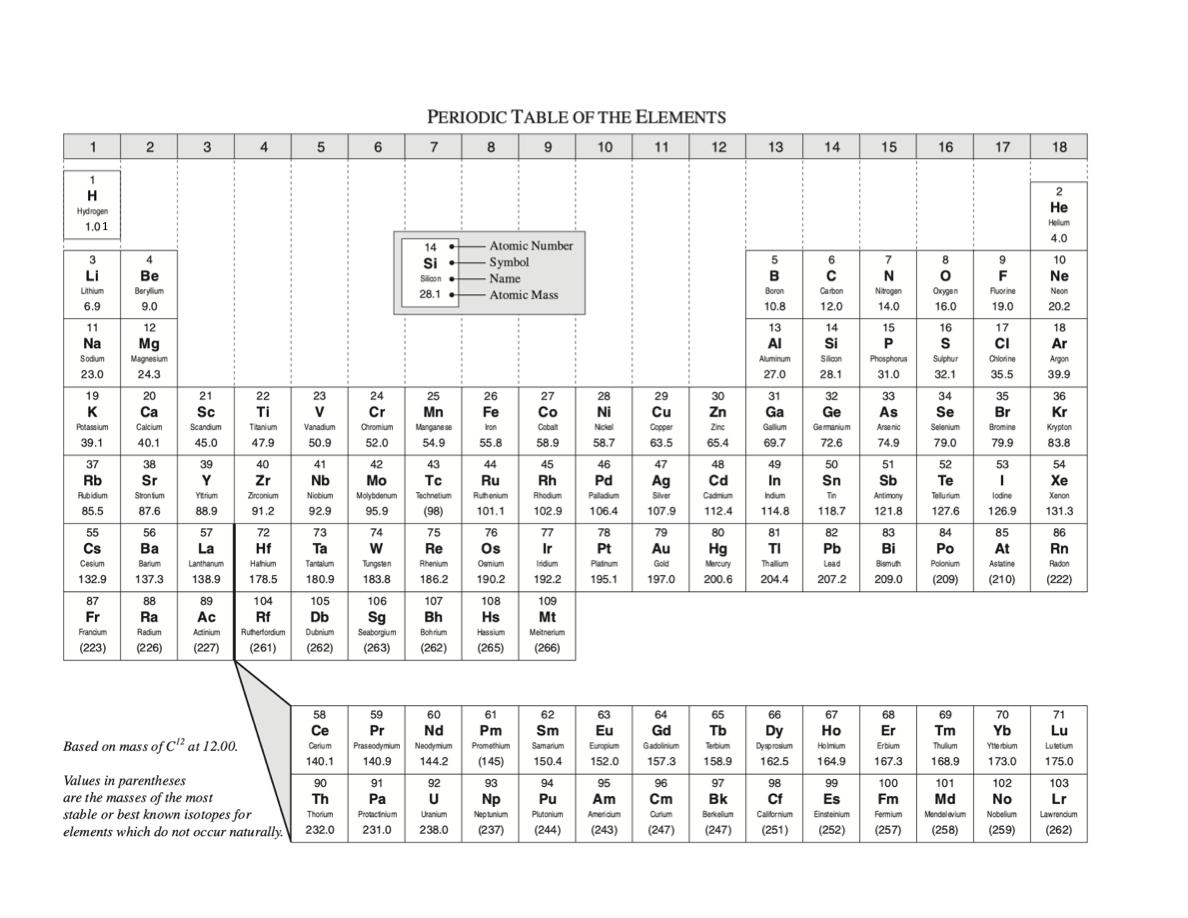
Periodic table of the elements — class-standard version, based on carbon-12 = 12.00
Use this table to read each element's group — the number of valence electrons an atom starts with is what decides how many bonds it forms and what charge its ion carries.
Ion Chart
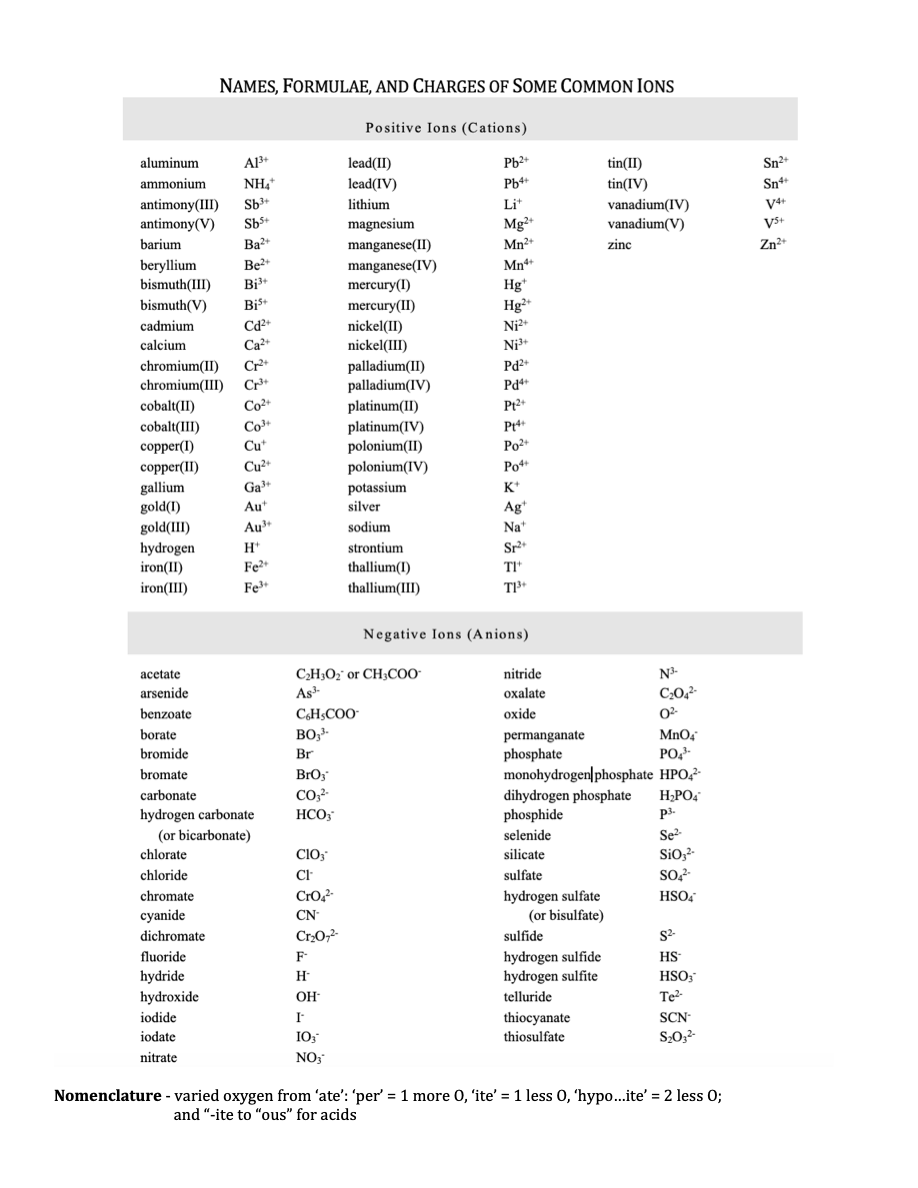
Class-standard chart · common cations, anions & polyatomic ions with their charges
Names, formulae, and charges of common ions — positive ions (cations) and negative ions (anions)
Every formula on the Naming and Formula Writing Rules tab traces back to this chart: read each ion's charge, then pick the subscripts that make the positive and negative charges cancel.
Summary — Nomenclature
One-screen reference
Decide the type, then name it
TypeWhat you seeHow to name it
Elementalone element, subscript 2just the element name (H2 = hydrogen)
Covalenttwo different non-metalsprefix + element, prefix + root + "-ide" (drop the first "mono-")
Ionicmetal + non-metal / polyatomicmetal name + anion "-ide"; Roman numeral if multivalent; no prefixes
Hydratesalt·xH2Osalt name + "(prefix)hydrate"; keep "mono-"
Must-memorise
Diatomic seven: H2, N2, O2, F2, Cl2, Br2, I2 — plus P4, S8.
Common names: H2O water · NH3 ammonia · CH4 methane.
Prefixes: mono 1, di 2, tri 3, tetra 4, penta 5, hexa 6, hepta 7, octa 8, nona 9, deca 10.
Common slips
● Prefixes on an ionic compound — never. CaCl2 is "calcium chloride", not "calcium dichloride".
● Forgetting the Roman numeral on Fe / Cu / Pb / Sn compounds.
● Naming O2 "dioxygen" — it is an element, just "oxygen".
● Speaking the "·" in a hydrate — it is silent.