Quantities in Chemical Reactions

SCH3U · Miss Peters · Moles · Molar Mass · Stoichiometry · Limiting Reactants · Percent Yield

← All units
The Mole
Avogadro's number — the chemist's counting unit
One mole = 6.02 × 10²³ particles
602,000,000,000,000,000,000,000
A mole (mol) is simply a count — like "a dozen" means 12, "a mole" means 6.02 × 10²³. That count is called Avogadro's number (NA). Particles can be atoms, molecules, or formula units — you must always say which.
How big is a mole, really?
Reference
One mole6.02 × 10²³
A mole is bigger by
A mole of seconds
If you counted one particle every second, without ever stopping, counting out a single mole would take about 1.9 × 10¹⁶ years — roughly 1.4 million times the current age of the universe. This is why chemists never count particles directly: they weigh them instead.
Atomic Mass & Molar Mass
Weighing one mole of something
Atomic mass
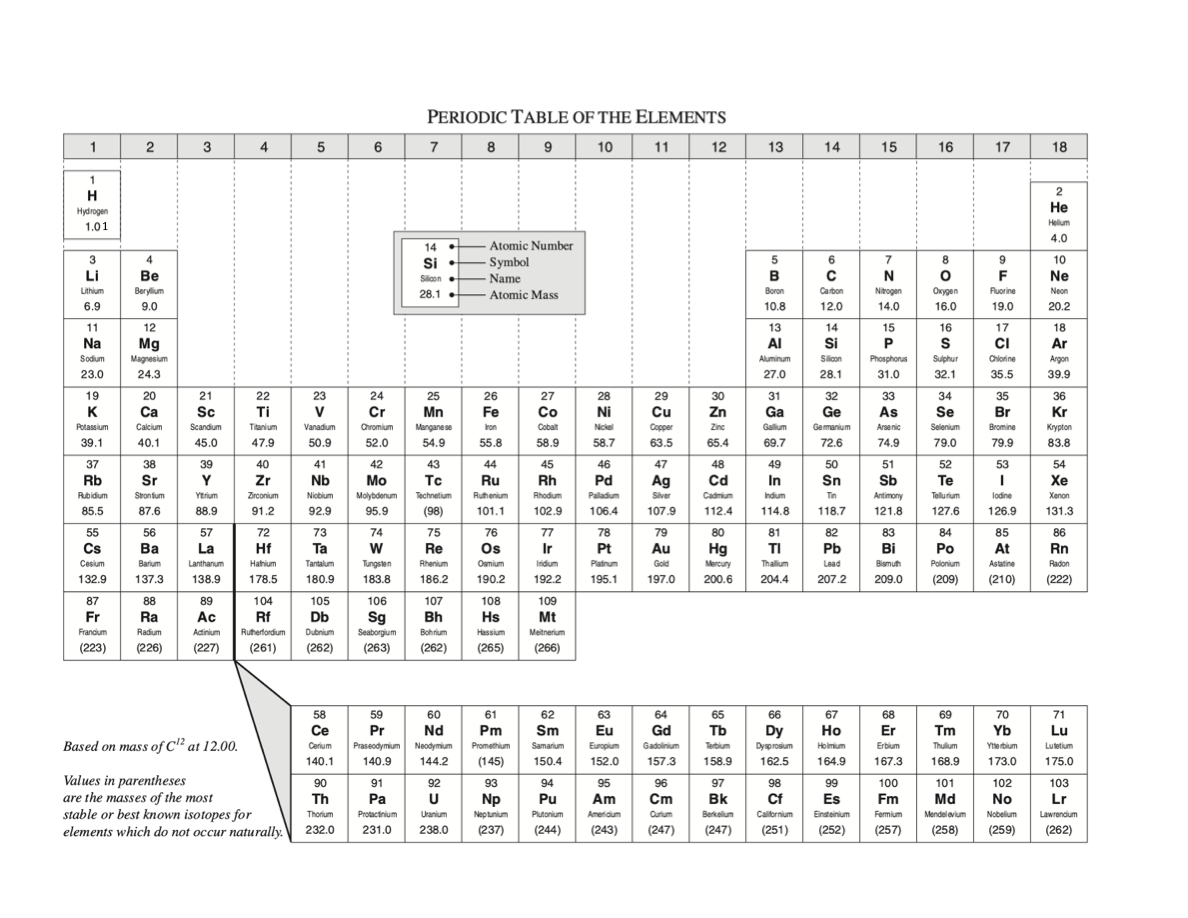
The mass of one mole of atoms of an element, in g/mol. Read it straight off the periodic table.

Fe = 55.8 g/mol  ·  O = 16.0 g/mol  ·  Cl = 35.5 g/mol
Molar mass
The mass of one mole of molecules (or formula units) of a compound, in g/mol. Found by adding up the atomic masses of every atom in the formula.

H₂ = 2(1.01) = 2.02 g/mol
Molar mass calculator
Periodic table lookup
Click an element to add it to the formula box
The Mole Road Map
Three equations — every route passes through moles
Volume ↔ moles
n = V / MV
MV = 22.4 L/mol at STP
Mass ↔ moles
n = m / mm
mm = molar mass (g/mol)
Particles ↔ moles
n = #p / NA
NA = 6.02 × 10²³ /mol
STP = Standard Temperature and Pressure, 0 °C and 1 atmosphere. The molar volume 22.4 L/mol applies to any gas at STP — it does not apply to solids or liquids.
Interactive road map
mm = 32.00 g/mol
Try these (from the slides)
Road map · moles → particles → atoms
Atoms from molecules
Mole Ratios
The coefficients of a balanced equation
A mole ratio comes straight from the coefficients of a balanced chemical equation. It only works if the equation is balanced — so balance first, always.

How to use it: divide by the coefficient of what you HAVE, multiply by the coefficient of what you WANT.
Mole ratio explorer
Mole ratio:
mol of ?
Stoichiometry Solver
Mole-mole · mole-mass · mass-mass · mixed
Every stoichiometry problem is the same journey: convert what you HAVE into molescross the mole ratio bridgeconvert moles into what you WANT. The quantity must be in moles before you use the mole ratio.

A mole-mole problem is 1 step, mole-mass is 2 steps, mass-mass is 3 steps. Same road, different starting points.
Solver
of
of
Energy Stoichiometry
Treating heat as another species in the equation
Endothermic
Heat ENTERS — it appears on the reactant side, because it is consumed.
A + B + 40.0 kJ → C + D
Exothermic
Heat EXITS — it appears on the product side, because it is released.
E + F → G + H + 120. kJ
Energy calculator
of
Reaction typeExothermic
Energy— kJ
DirectionReleased
Limiting Reactants
Whatever runs out first decides how much you can make
The limiting reactant (LR) is the one that gets used up first. It caps how much product can form. Everything else is in excess and some of it will be left over when the reaction stops.
⚠ Careful — a very common trap. The limiting reactant is not simply "the one with the fewest moles". You must divide each reactant's moles by its coefficient first, then take the smallest result.

In CH₄ + 2O₂ → CO₂ + 2H₂O with 2.50 mol CH₄ and 4.80 mol O₂: fewest moles would wrongly say CH₄ — but 2.50 ÷ 1 = 2.50 while 4.80 ÷ 2 = 2.40, so O₂ is actually limiting. Always divide by the coefficient.
🍔 Build a double cheeseburger
Recipe: 1 bun · 1 tomato slice · 1 lettuce leaf · 2 cheese slices · 2 patties
Burgers made0
Limiting ingredient
Left over
🚲 Quick check — bicycles
1 frame + 2 wheels → 1 bicycle
2
6
Limiting reactant calculator
Limiting reactant
In excess
Product formed
Excess left over
Visualising it — 10 H₂ + 7 O₂
2 H₂(g)+ O₂(g)→ 2 H₂O(g)
Initial10 mol7 mol0 mol
Change−10 mol−5 mol+10 mol
Final0 mol2 mol10 mol
H₂ runs out completely — it is the limiting reactant. Two moles of O₂ are left over as excess.
Theoretical, Actual & Percent Yield
How close did the lab get to the calculation?
Theoretical yield — what stoichiometry says you should get. Always calculated.

Actual yield — what you really scraped out of the flask. Always measured.
% yield = actual yield × 100
theoretical yield
Actual yield is almost always lower than theoretical — product is lost on filter paper and glassware, reactions run incompletely, and side reactions steal material. A % yield above 100 % usually means the product is still wet or contaminated.
Percent yield calculator
g
g
Percent yield
Product lost
Verdict
Quantities Kahoot
30 questions · 20 seconds each · Speed bonus scoring
🐹
Ready to test your knowledge?
Covers moles, molar mass, the three mole equations, mole ratios, stoichiometry, energy, limiting reactants & percent yield
30
Questions
20s
Per question
1000
Max points
Summary
Quick reference
ConceptEquationNotes
Avogadro's numberNA = 6.02 × 10²³ /molParticles = atoms, molecules or formula units
Volume ↔ molesn = V / MVMV = 22.4 L/mol — gases at STP only
Mass ↔ molesn = m / mmRearranged: m = n × mm
Particles ↔ molesn = #p / NARearranged: #p = n × NA
Mole ratio÷ coefficient of HAVE, × coefficient of WANTRequires a balanced equation
Limiting reactantsmallest of (moles ÷ coefficient)Not simply the fewest moles
Excess left overmoles at start − moles usedMoles used comes from the LR via stoichiometry
Percent yield(actual ÷ theoretical) × 100Theoretical = calculated, actual = measured
Energy: endothermic → heat on the reactant side (absorbed) · exothermic → heat on the product side (released)
Golden rule: the quantity must be in moles before you cross the mole ratio bridge.