A chemical change forms a new substance — but how can you tell?
Chemical Change Clues
A chemical change is any change in which a new substance is formed. You can't always see the molecules,
but five kinds of evidence tip you off. Hover a clue to highlight it.
Chemical Change Clues
Spot the evidence
Watch each scenario, then click which type of evidence you observe.
Chemical Equations & Conservation of Mass
Reactants are used up · products are created · matter is never lost
What a chemical equation shows
A chemical equation represents a reaction using: chemical formulas,
the relative number of entities (coefficients), and the states of matter.
A reactant is a chemical used up in the reaction.
A product is a chemical created during the reaction.
2H2O → 2H2 + O2
↑ reactantproducts ↑
Law of Conservation of Mass
The total mass before a reaction equals the total mass after.
Matter cannot be created nor destroyed — so every atom on the left must reappear on the right.
That's why we balance equations.
Cu + AgNO3 → Ag + Cu(NO3)2
Balancing Chemical Reactions
Add coefficients until every element's atom count matches on both sides
Interactive balancer
Presets from the slides
Strategy tips for balancing
Balance compounds first, elements last.
Only add coefficients — NEVER change subscripts.
Balance metals first, then nonmetals, then H & O.
If H and O appear in more than one place, balance them last.
Multiply coefficients × subscripts to count atoms.
Polyatomic ions (SO42−, OH−, NO3−) can be balanced as a whole group.
If even numbers don't work as coefficients, try odd numbers.
Use diagrams to help if you're stuck.
Balanced Equations from Word Equations
Word equation → skeleton (correct formulas) → balanced
Three-step converter
Word equation
Type -> or → for the arrow. Subscripts and coefficients are just normal numbers (H2O, 2H2O).
Elements combine (synthesis) · a compound splits into elements (decomposition)
Simple synthesis
Two elements combine to form one compound: A + B → AB.
If one reactant is O2, it's also combustion (e.g. 2Mg + O2 → 2MgO).
Simple decomposition
A compound breaks down into its elements: AB → A + B.
Predict the product
Synthesis
Balanced products:
Predicting Products — Single Displacement
A + BC → AC + B · only if A is more reactive than B
Activity series (reference)
most reactive → least reactive
Metal activity series
Halogen activity series
A reaction only occurs if the free element is higher (more reactive) than the one it's trying to replace. The zones show what each metal reacts with.
"Will it react?" simulator
Metals reacting with acids
Many metals react with acids to give a salt + hydrogen gas:
Zn(s) + 2HCl(aq) → ZnCl2(aq) + H2(g).
Metals below hydrogen (Cu, Hg, Ag, Au) do not react — the answer is NR.
Predicting Products — Double Displacement
AD + BC → AC + BD · the positive ions swap partners
Acid–base (neutralization)
acid + base → salt + water, always.
NaOH + HCl → NaCl + H2O
Precipitation
two aqueous solutions → a low-solubility precipitate (s).
2NaOH + CuCl2 → 2NaCl + Cu(OH)2(s)
Ion-swap predictor
Hydrocarbon Combustion
Fuel + O2 → complete: CO2 + H2O · incomplete: + CO + C
Combustion simulator
Combustion type
Products
Balanced (complete)
Complex Synthesis & Decomposition
Four matching pairs — each synthesis pattern reverses to a decomposition
Pattern flashcards (click to flip)
Test yourself
Predict the product for each pattern.
Double Displacement Reactions Forming a Gas
Some double-displacement products are unstable and break down into a gas + water
The three unstable products
If a DD reaction forms…
It breaks down into…
H2CO3 (carbonic acid)
CO2(g) + H2O(l)
H2SO3 (sulfurous acid)
SO2(g) + H2O(l)
NH4OH (ammonium hydroxide)
NH3(g) + H2O(l)
Two-step walkthrough
State Symbols
(s) solid · (l) liquid · (g) gas · (aq) aqueous
General rules
Metals are solid (s) — except Hg is liquid (l).
Water is liquid (l) — except in combustion it's usually gas (g).
Common gases: O2, CO2, CO, NH3.
HOFBrINCl diatomics are all gases — except Br2 is liquid, I2 is solid.
Ionic compounds tend to be solid; covalent can be s, l, or g.
Acids are always aqueous (aq); ionic compounds dissolved in water are (aq).
State symbol drill
Reactions in the Real World
Where each of the five reaction types shows up outside the lab
Everyday examples by reaction type
🛤️ Thermite welding — single displacement in action
A crucible of aluminium powder and iron(III) oxide is lit. Aluminium rips the oxygen away from the
iron — 2Al + Fe2O3 → Al2O3 + 2Fe —
releasing enough heat (> 2500 °C) to pour molten iron straight into a gap between two
lengths of railway track, fusing them into one continuous rail.
Why it matters
Incomplete combustion & carbon monoxide. When a furnace, car engine or gas heater
doesn’t get enough O₂, it also produces CO — a colourless, odourless, toxic gas.
That is why homes have CO detectors and why you never run an engine in a closed garage.
Corrosion costs billions. Rusting is the synthesis reaction
4Fe + 3O₂ → 2Fe₂O₃. Galvanising (a zinc coating) and
sacrificial anodes use single displacement — the more reactive metal corrodes instead of the iron.
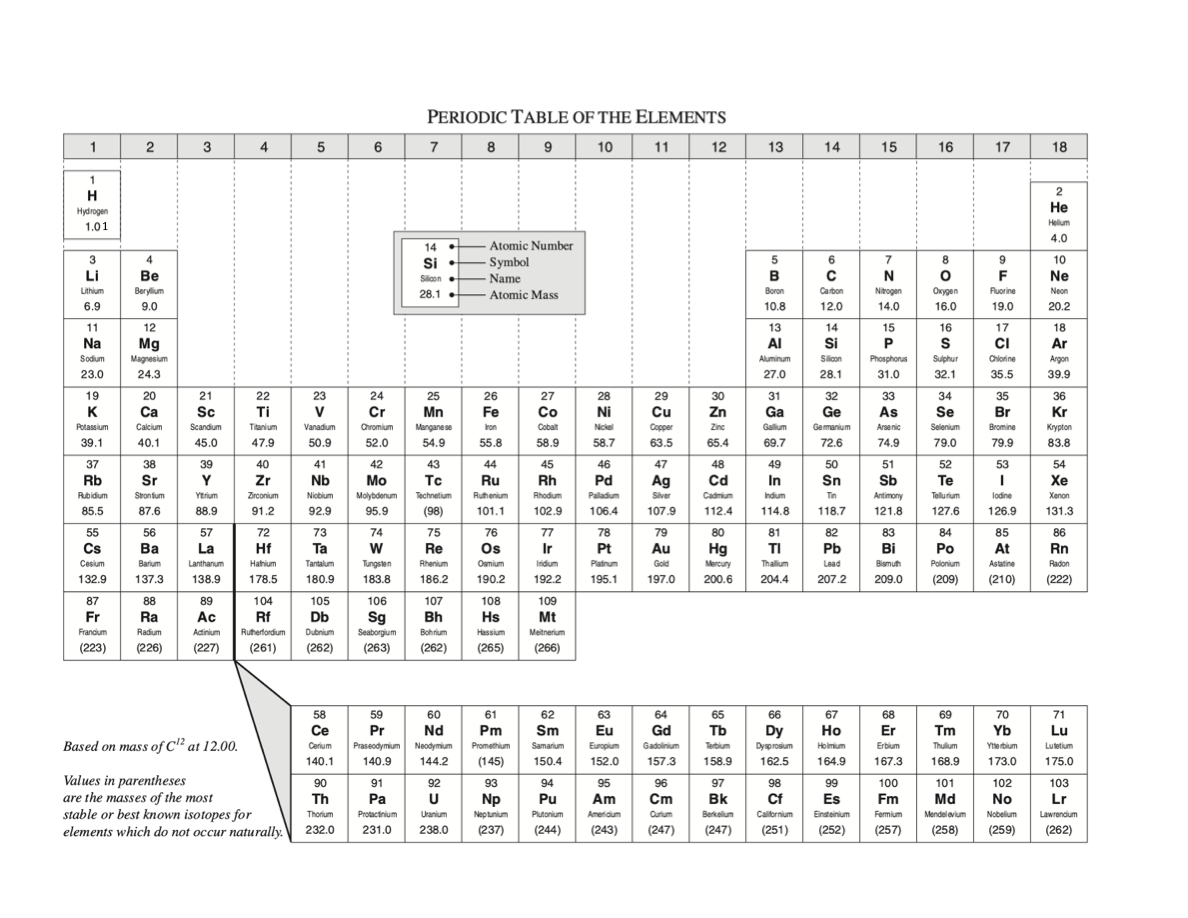
Periodic Table
Class-standard table · based on mass of carbon-12 = 12.00
Use this table for symbols, atomic numbers and molar masses when predicting products and balancing equations.
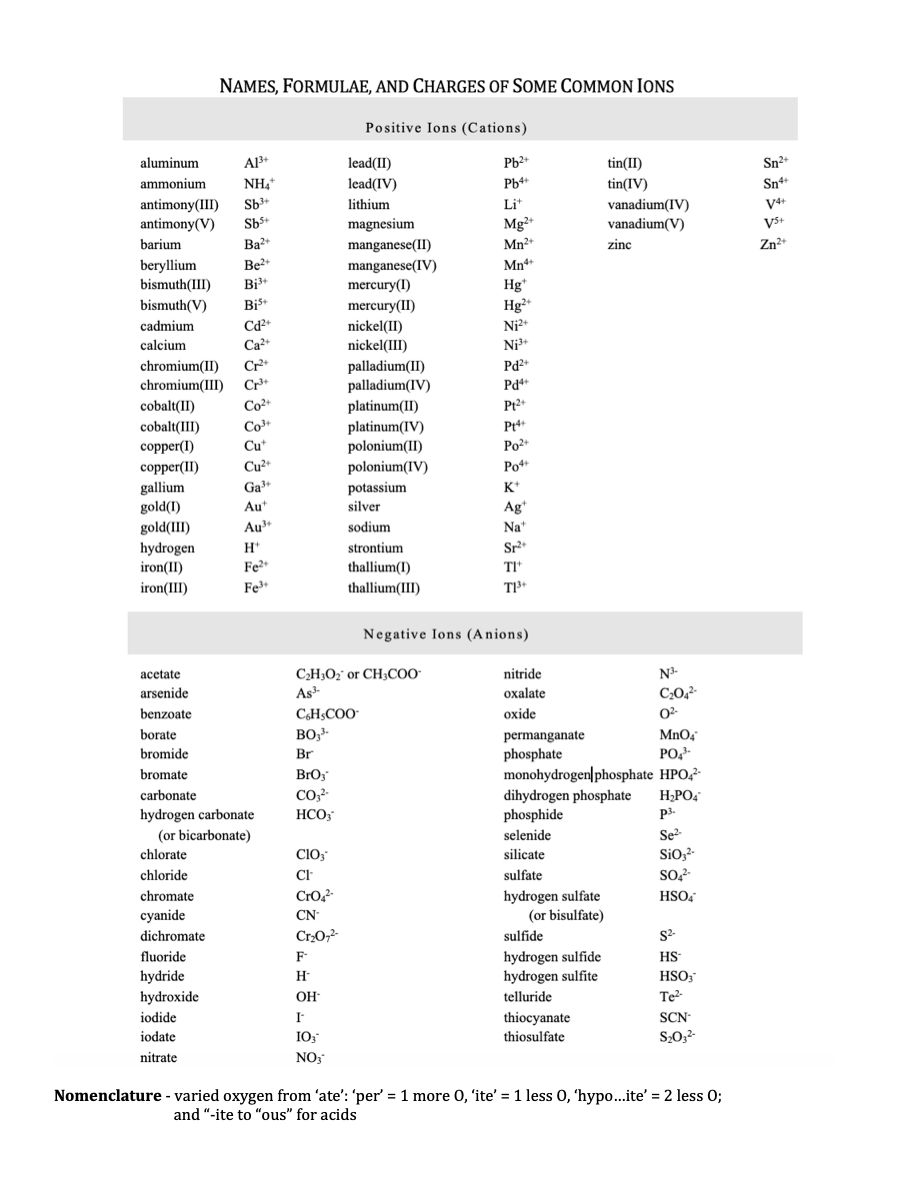
Ion Chart
Class-standard chart · common cations, anions & polyatomic ions with their charges
Use these charges to write correct formulas for the reactants and products before you balance — the subscripts come from making the positive and negative charges cancel.
Chemical Reactions Practice Quiz
28 questions · 20 seconds each · Speed bonus scoring
🧪
Ready to test your knowledge?
Covers evidence, balancing, the five reaction types, predicting products, activity series & state symbols